

Table of Contents
Most teams do not have a talking problem. They have a listening problem, a clarity problem, and a trust problem dressed up as a talking problem. That is exactly what good communication skills games are built to fix.
At Taki Taki Games, we get asked the same question every week from managers, teachers, and team leads: “What communication skills games actually work, and which ones are just filler?” This guide answers that honestly. No padded lists of forty generic icebreakers. Just the games worth your time, sorted by the skill they build, plus how to run them so they stick.
What Are Communication Skills Games, and Why Do They Work?
Communication skills games are structured activities that put people inside a deliberate constraint, no talking, no seeing, one word at a time, so a bad habit becomes visible fast. You cannot fix what you cannot see, and a fifteen minute game surfaces problems that a two hour meeting will politely ignore.
The reason these games work better than a lecture is simple. Telling someone “listen more carefully” changes nothing. Putting them in a game where poor listening produces an obviously wrong drawing changes a lot. The lesson lands because they felt it happen.
Active Listening Communication Skills Games
Listening is the skill most teams think they have and least often practice. These games make the gap impossible to ignore.
1. Back-to-Back Drawing
Two people sit back to back. One describes an image using only shapes and positions. The other draws it blind. Compare the drawing to the original and you will see, instantly, where the instructions broke down. Fifteen minutes, paper, two pencils.
2. Paraphrase Pairs
One person tells a short story. The other must paraphrase it back before responding with their own thoughts. It sounds easy. It rarely is. This is one of the few communication skills games that transfers directly into everyday one on one conversations at work.
3. Broken Telephone
The classic whisper-down-the-line game still earns its place. The point is not the game itself, it is the debrief afterward: how many people did that message pass through today, and how much of it survived?
Verbal Clarity Games
If your team writes long emails and explains simple things in complicated ways, these games target that exact habit.
4. Taboo
Describe a word without using the five words most associated with it. Great for teaching people to explain ideas in someone else’s language instead of their own jargon.
5. In So Many Words
Ask someone to explain something in twenty five words, then ten, then five, without losing the meaning. Few games teach concision this fast or this uncomfortably.
6. Stand Up for Fillers
A speaker talks for two minutes on any topic. The group stands up every time they hear “um,” “like,” or “so.” It is a little brutal the first time, but nobody forgets it.
Nonverbal Communication Skills Games
A large share of what we communicate has nothing to do with words. These games make that visible.
7. Charades
Still one of the most reliable games ever invented for this, because acting something out without speaking forces real clarity of thought.
8. Mirror Me
Two people face each other. One leads with slow movements, the other mirrors exactly. It builds awareness of pace, timing, and how much we read from a partner’s body before they say a word.
9. Birthday Lineup
The whole group must line up in order of birth month and day without speaking. Watch how fast people invent their own sign language.
Trust and Instruction-Giving Games

Some of the oldest communication skills games exist because trust and clear instruction go hand in hand.
10. Minefield
Set up a simple obstacle course. Blindfold one person. A partner guides them through using only voice. If the blindfolded person touches an obstacle, the pair starts over.
11. The Perfect Square
A blindfolded group holds a length of rope and, using only spoken direction, tries to form a perfect square on the floor. It takes longer than anyone expects.
Also Read: One Minute Games
Virtual Communication Skills Games for Remote Teams
Remote work strips away most of the nonverbal cues teams rely on, so virtual sessions need games built for that gap.
12. Can You Hear Me Now?
One person describes a simple object over a call while others draw it based only on the description, no questions allowed. Compare drawings at the end.
13. Guess the Emoji
Send a phrase using only emojis and let the team decode it. Simple, quick, and surprisingly good at teaching how much context we lose in text based communication.
14. Online Pictionary
A screen-share drawing tool and a shared word list are all you need. It works well as a five minute warm up before a meeting that needs full attention.
Also Read: Minute To Win It Games
The Debrief Is What Makes Communication Skills Games Actually Work
Here is the part most guides skip. The game is only half the exercise. Without a debrief, these games are just fun for fifteen minutes and forgotten by lunch.
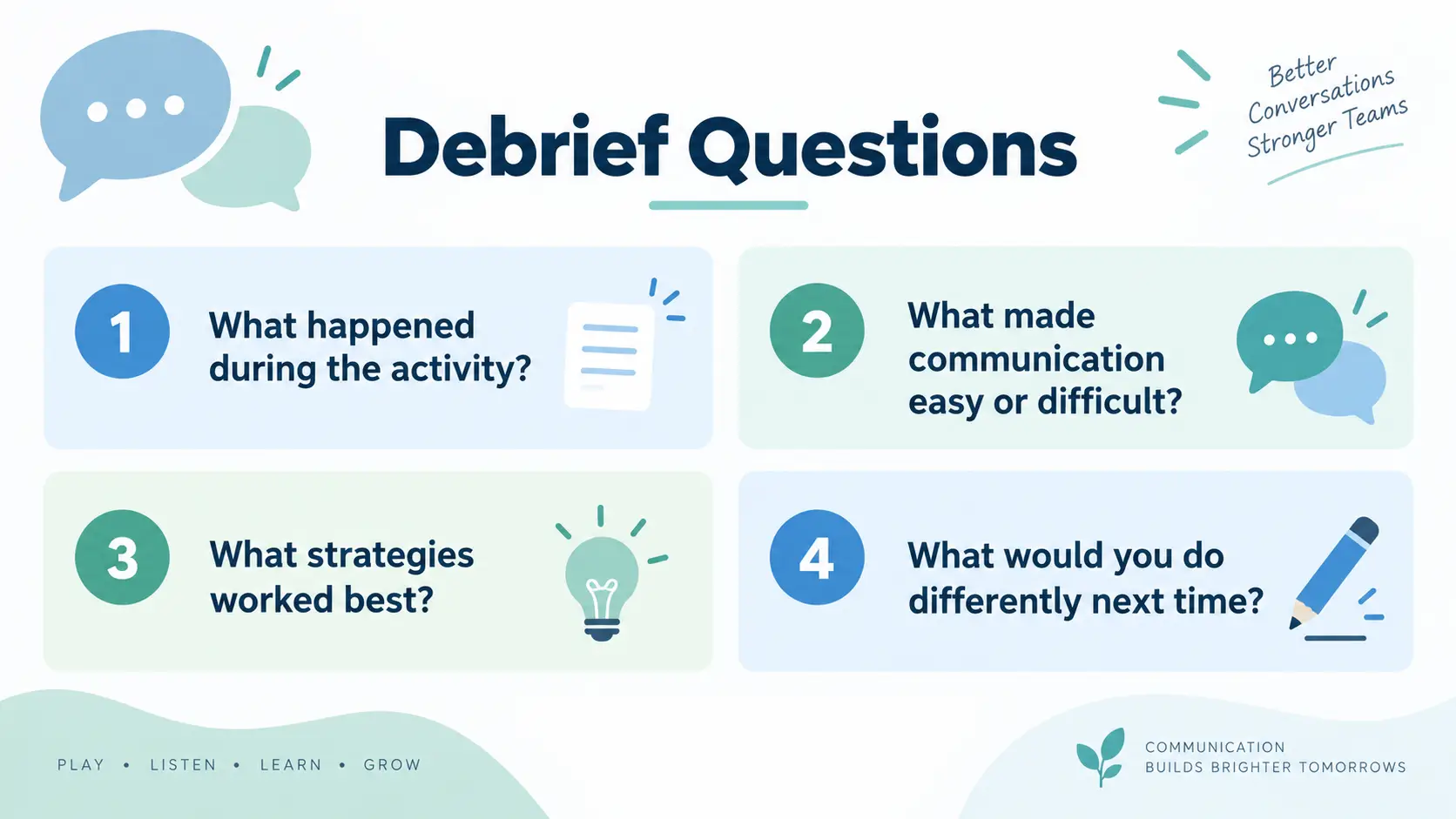
15. The Four Question Debrief
Run this after any game on this list. Ask the group: What did you assume going in? Where exactly did clarity break down? What does that look like in our actual work? What is one thing you will change this week?
Keep it to ten minutes. Do not let one person dominate the answers, and do not skip it because time is tight. The debrief is where communication skills games turn from entertainment into an actual habit change.
A few practical notes before you run any of these. Match the game to the problem you are actually seeing. If meetings drag because two people always talk over everyone else, run a listening game, not a trust fall. If your team writes bloated updates, run In So Many Words before you run Charades. Keep sessions between fifteen and thirty minutes including the debrief, longer sessions lose energy fast. And rotate games regularly. The same three games repeated every month stop teaching anything new after the second run. Group size matters too. A pair-based drawing exercise works fine with four people or forty, while a rope circle or a full obstacle course needs a minimum headcount to feel real. Check the room, check the clock, and pick accordingly before you commit to a specific format.
Also Read: Team Building Activities in Bangalore
Final Thoughts on Choosing the Right Communication Skills Games
Good communication skills games are not about killing time before a meeting starts. They are a fast, low stakes way to expose exactly where a team’s communication breaks down, whether that is listening, clarity, trust, or reading a room without words. Pick one game that matches a real problem your team has this week, run it, then spend ten minutes talking honestly about what happened.
At Taki Taki Games, this is the approach we build every session around: fewer games, better debriefs, real change. Start with one game from this list, run the four question debrief, and see what your team actually needed to hear.